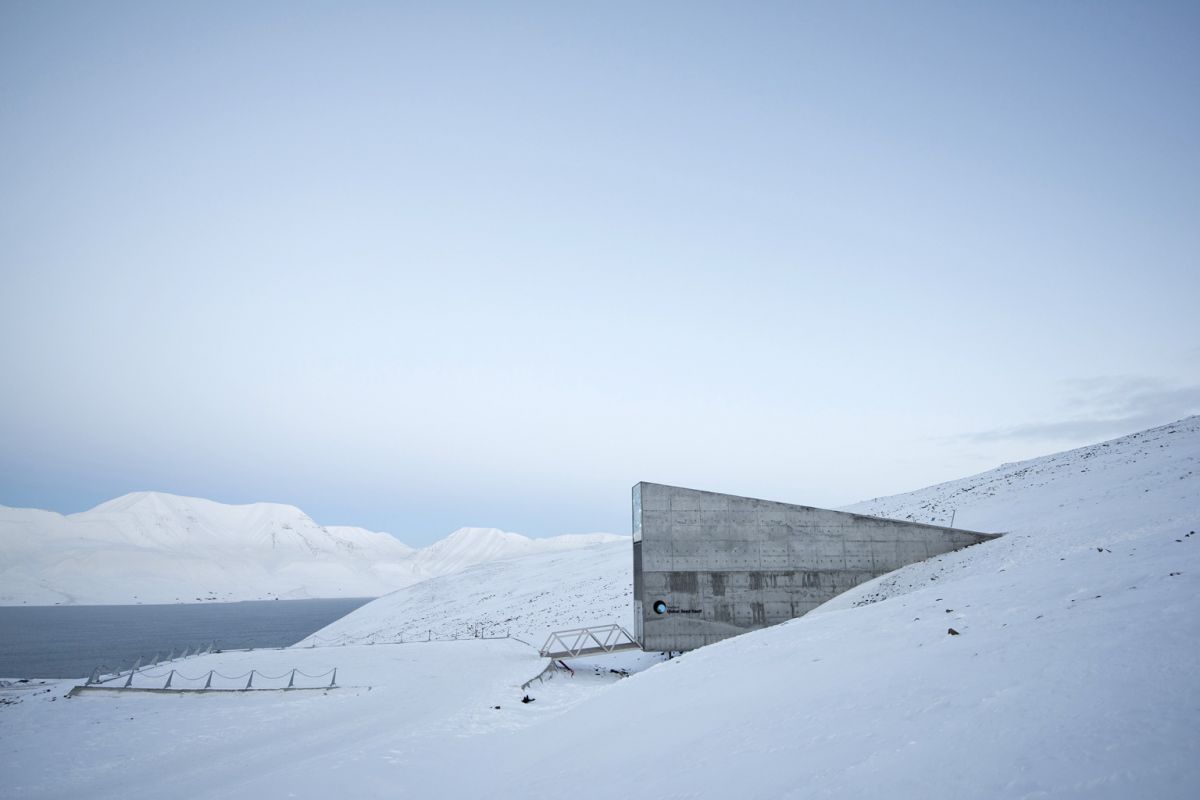
Deep within a mountain on a remote Arctic island in Norway’s Svalbard archipelago is a vault which safeguards humanity’s food supply for generations to come.
The Svalbard Global Seed Vault, which lies halfway between mainland Norway and the North Pole, is a fail-safe seed storage facility which holds the world’s largest collection of crop biodiversity.
With almost one million seed varieties, and counting, it is the ultimate insurance policy against the catastrophic loss of collections from other repositories.
Mankind will have used up its allowance of natural resources such as water, soil and clean air for all of 2019 by Monday (July 29), a report said.
The so-called Earth Overshoot Day has moved up by two months over the past 20 years, and this year’s date is the earliest ever, the study by the Global Footprint Network said.
The equivalent of 1.75 planets would be required to produce enough to meet humanity’s needs at current consumption rates.
“Earth Overshoot Day falling on July 29 means that humanity is currently using nature 1.75 times faster than our planet’s ecosystems can regenerate. This is akin to using 1.75 earths,” the environmental group, which is headquartered in Oakland, California, said in a statement.
“The costs of this global ecological overspending are becoming increasingly evident in the form of deforestation, soil erosion, biodiversity loss, or the buildup of carbon dioxide in the atmosphere. The latter leads to climate change and more frequent extreme weather events,” it added.
Calculated since 1986, the grim milestone has arrived earlier each year.
In 1993, it fell on Oct 21, in 2003 on Sept 22, and in 2017 on Aug 2.
“We have only got one Earth – this is the ultimately defining context for human existence. We can’t use 1.75 (earths) without destructive consequences,” said Mr Mathis Wackernagel, founder of Global Footprint Network.
Ms Maria Carolina Schmidt Zaldivar, Chile’s environment minister and chair of the Climate COP25 scheduled this December in its capital Santiago, said a major cause of the date falling earlier and earlier was growing amounts of carbon dioxide emissions.
“The importance of decisive action is becoming ever more evident,” she said.
Nordic countries are experiencing searing temperatures as Europe’s record-breaking heatwave moves north, the Swedish Meteorological and Hydrological Institute (SMHI) said yesterday, with some areas recording “tropical nights”.
In Sweden, the most extreme heat has headed straight for the country’s far north.
On Friday, the small town of Markusvinsa in the far north recorded a temperature of 34.8 deg C, the highest mark reached in all of Sweden so far this year.
“That’s the hottest temperature in the far north since 1945 and the third-highest temperature on record,” SMHI meteorologist Jon Jorpeland told Agence France-Presse.
Last week, several places in Sweden experienced “tropical nights”, meaning that temperatures stayed above 20 deg C throughout the night.
The tropical heat was also being felt in other Nordic countries, and the Norwegian Meteorological Institute said yesterday that it had recorded “tropical nights” in 20 different locations in southern Norway.
Heat warnings have been issued in Sweden, Norway and Finland, and last week, Finnish police even warned motorists to be mindful of moose, which were increasingly crossing roads in search of water to quench their thirst.
Meanwhile, the heatwave that smashed national temperature records in Belgium, Germany and the Netherlands, and which baked Paris in its highest-ever temperature of 42.6 deg C in the middle of last week, has dissipated a little, but many travellers faced disrupted journeys.
The mercury dived in France with outbreaks of drizzle as state weather service Meteo-France lifted red alerts imposed in 20 departments.
In Germany, the country’s highest mountain Zugspitze – standing at 2,962m – was still almost completely covered in snow despite a national temperature record of 42.6 deg C in the north on Thursday.
“The thick snow cover has provided a buffer against (the mountain) absorbing the high temperatures this year,” a spokesman for the research station at Zugspitze said.
Commuters and holidaymakers saw travel plans blighted with disruption to air and rail services in several European countries.
Flights at London’s Heathrow and Gatwick airports were cancelled and delayed – some by more than two hours – with holiday destinations such as Alicante, Rome and Lisbon affected.
Elsewhere in the British capital, there was still travel havoc due to rails buckling under the heat and fires breaking out along commuter lines.
The Met Office advised against non-essential travel.
At Paris’ Gare du Nord, an electrical failure halted domestic and international high-speed trains during Friday lunchtime, including Eurostar and Thalys services, although traffic gradually resumed.
Thalys – which links Paris to Brussels, Amsterdam and Cologne – also saw disruption, with slow trains amid fears that infrastructure could overheat.
At the peak of the heatwave, temperatures on the tracks soared to up to 15 deg C higher than that of the air.
In Switzerland, train engineers painted rails white to reflect the heat of the sun.
In northern and central France, the heatwave has been particularly brutal in the countryside, aggravating fires which have seen thousands of hectares of crops destroyed.
“More than 3,200ha have already gone up in flames since the start of summer,” Interior Minister Christophe Castaner said.